Documented hub1. Institutional infrastructure
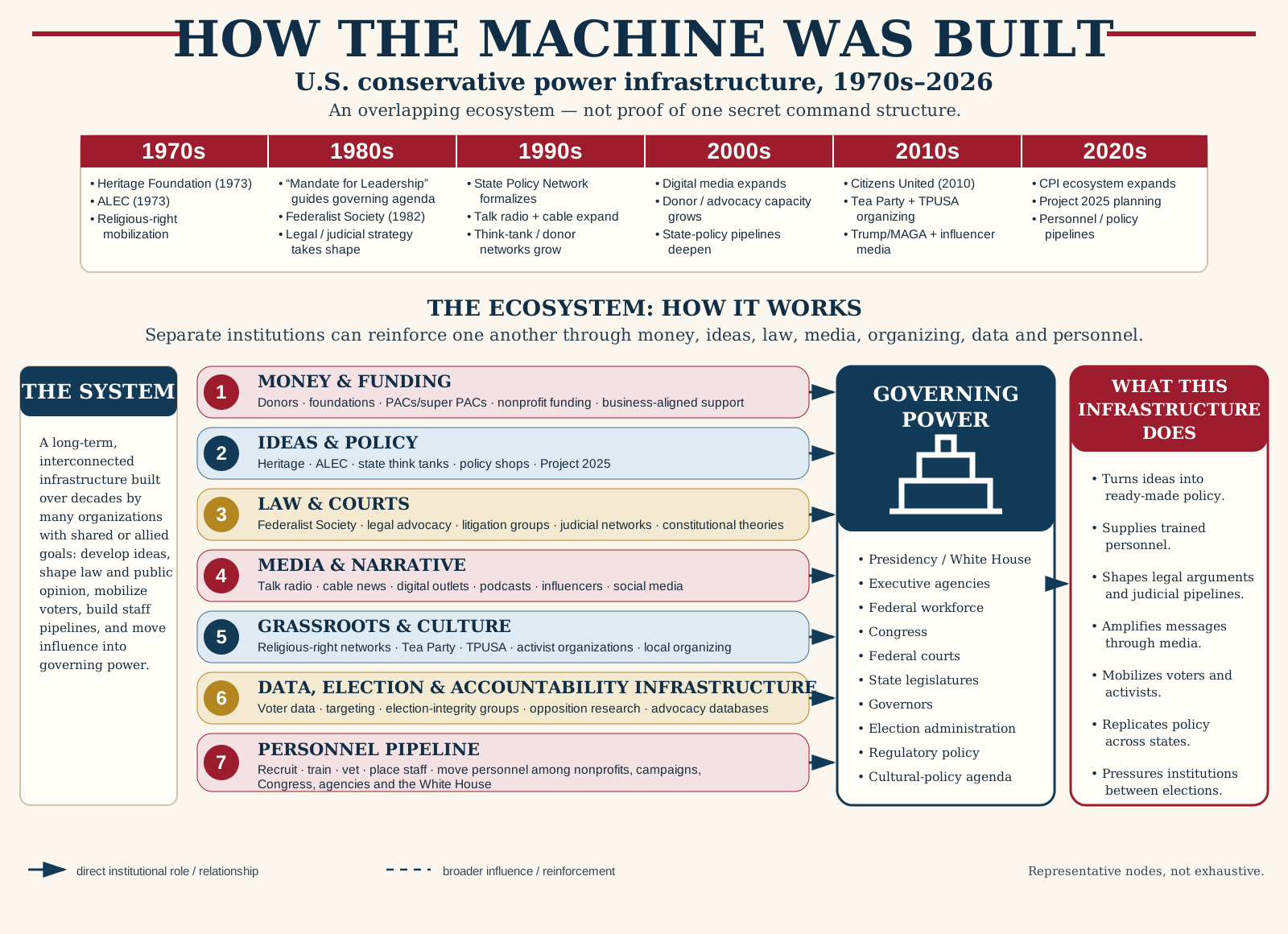
Organizations that provide staffing, administrative support, legal capacity, policy development, networking, training or physical space can function as infrastructure for a broader political ecosystem. Current research includes the Conservative Partnership Institute and organizations associated with its wider network, while keeping each entity's legal identity and activities distinct.
Documented personnel2. People and personnel pipelines
Repeated movement among advocacy organizations, campaigns, congressional offices, think tanks, legal groups and executive-branch positions can show how ideas and operating knowledge travel. Personnel overlap is documented first; influence is assessed separately.
Strong pattern3. Executive power and legal strategy
One major branch examines legal theories and policy work aimed at expanding presidential control over the executive branch, then compares those ideas with appointments, executive actions, agency practice and litigation.
Active record4. Elections, voter data and administration
This branch follows voter-list systems, election-integrity organizations, federal and state litigation, government requests for voter data, election-monitoring plans and the origin of large datasets when the source can be established. Unknown sources stay labeled unknown.
Open-source inquiry5. Money, technology and access
We track disclosed donors, contracts, corporate interests, technology vendors, political spending and social or institutional access where public records allow it. The objective is to distinguish financial benefit from mere proximity.
Outcome test6. Who benefits?
The final test is not only who gains formal power. It is whether policies and institutional changes improve or reduce security, liberty, representation, economic opportunity and accountability for ordinary people.